Xiamen Municipal Market Supervision Bureau launched a special study: exploring the guidelines for cleaning and disinfection of tableware.
China Food Safety Network News (Lai Cairu, Lin Weiyan, Huang Lin, reporter Chen Jiahua) Whether reusable tableware is clean and hygienic has always been the focus of diners’ attention. Sampling data in recent years show that the main problems of reusable tableware are anionic synthetic detergent and coliform bacteria exceeding the standard. The reason is that on the one hand, the operators do not carefully clean and disinfect the tableware after use; On the other hand, operators do not have the correct awareness of cleaning and disinfection. How do you wash the tableware? Is the "pre-meal ceremony" for consumers to iron tableware before meals useful? In this regard, Xiamen Municipal Market Supervision Bureau has carried out special research to explore the relatively scientific cleaning and disinfection guidelines for reusable tableware in two ways: small and large business entities, hand washing and machine washing.
"Noun:Reuse tableware refers to the tableware that catering service units provide to consumers for reuse after cleaning and disinfection.
Research results:
I. Hand-washing tableware in small and medium-sized catering units

Commodity logo Image source: Xiamen Municipal Market Supervision Bureau
(1) Use qualified detergent. Detergents whose implementation standards are National Standard Detergent for Food Safety (GB 14930.1-2022) or Detergent for Hand Washing Tableware (GB/T 9985-2000) should be purchased, and the product use is better for Class A (Class A can be directly used for cleaning food).
(2) Rinse twice or rinse with running water to clean the detergent. The higher the content of anionic synthetic detergent in detergent, the stronger the decontamination ability; However, it is necessary to clean the tableware according to the recommended dosage of the label, and rinse it twice or use running water for 6-10 seconds to completely remove the anionic synthetic detergent.
(3) the disinfection time is enough to effectively sterilize. Boiling water for 10 minutes, sterilizing in ultraviolet disinfection cabinet for 30 minutes or sterilizing in high temperature disinfection cabinet with hot air for 20 minutes or more can completely kill coliforms.
Ⅱ. Machine-washed Tableware in Large Catering Units
(1) Machine-washed detergent generally uses alkaline ingredients to remove dirt, and does not contain anionic synthetic detergent ingredients.
(2) After machine washing, it can be sterilized by drying or disinfection. If a basket dishwasher is used for cleaning, the tableware should be spread out and placed after washing, and the surface moisture should be dried by residual temperature; If it is cleaned by a channel conveyor dishwasher, it needs to be disinfected separately, which can effectively kill coliforms.
"Research experiment:
I. Hand-washing tableware in small and medium-sized catering units
-How to choose hand washing detergent?
In this study, three kinds of hand-washed tableware detergents commonly used by unqualified catering service units were selected (sampled by restaurants)-White Cat Lemon Black Tea Detergent, Kitchen Multifunctional Detergent, Jinyue Brand Lemon Detergent, and one kind of Minchu Brand Lemon Detergent, which was popular online.

Commodity samples Image source: Xiamen Municipal Market Supervision Bureau
According to the national standard detergent for food safety (GB 14930.1-2022), whether the above detergents meet the national mandatory standards was tested. According to the Standard Test Method for Drinking Water (GB/T 5750.4-2006), the content of anionic detergent components in detergent was detected. According to "Detergent for Hand Washing Tableware" (GB/T 9985-2000), artificial dirt was prepared and the detergency of detergent was evaluated.

Preparation of samples Image source: Xiamen Municipal Market Supervision Bureau
The preparation process of artificial dirt: butter, lard and vegetable oil are evenly mixed according to the ratio of 1: 1: 2, and glycerol monostearate accounting for 5% of the total mass is added to make mixed oil; Mixed oil, wheat flour, whole milk powder, fresh whole egg liquid and distilled water (accounting for 15%, 15%, 7.5%, 30% and 32.5% in turn) were evenly mixed to make artificial dirt.
The results show that: (1) Detergents should meet the national standard. The above four detergents all meet the national mandatory standards. (2) The higher the content of anionic synthetic detergent, the stronger the detergency. Among the four detergents, white cat lemon black tea detergent has the highest content and the strongest detergency. (3) Sterilizing detergent can inhibit bacteria. The detection rate of coliform bacteria washed with white cat lemon black tea detergent containing sterilization ingredients decreased from 100% to 20%.
-What’s the process of washing dishes by hand?
Simulate the actual operation of hand-washing tableware in small and medium-sized restaurants, set up a washing pool and a rinsing pool, add 0.2-0.3% detergent for hand-washing tableware to the water in the washing pool, and manually scrub the tableware one by one in the washing pool to ensure that there is no food residue on the surface of the tableware, and then carry out the following three treatments: (1) rinse the tableware in the rinsing pool once; (2) After the first rinsing, the rinsing pool is replaced with tap water for the second rinsing; (3) Wash the tableware with residue directly with running water one by one, and the washing time of each tableware isSix to ten seconds.

Cleaning experiment Image source: Xiamen Municipal Market Supervision Bureau
The results show that: (1) Rinsing twice is effective. Anionic synthetic detergent was still detected in 10% of tableware after only one rinse. After the new water was replaced and rinsed for the second time, the residue of anionic synthetic detergent was not detected. (2) The washing effect of running water is good, and the residue of anionic synthetic detergent is not detected.
-How to achieve good disinfection effect?
The cleaned tableware is disinfected by boiling water, ultraviolet tableware disinfection cabinet and high temperature disinfection cabinet, which are mainstream in small and medium-sized restaurants. The results show that the coliform bacteria on the surface of tableware can be effectively killed by boiling water for 10 minutes, sterilizing in ultraviolet disinfection cabinet for 30 minutes and sterilizing in high temperature disinfection cabinet with hot air for 20 minutes or more.
Ⅱ. Machine-washed Tableware in Large Catering Units and Hotels
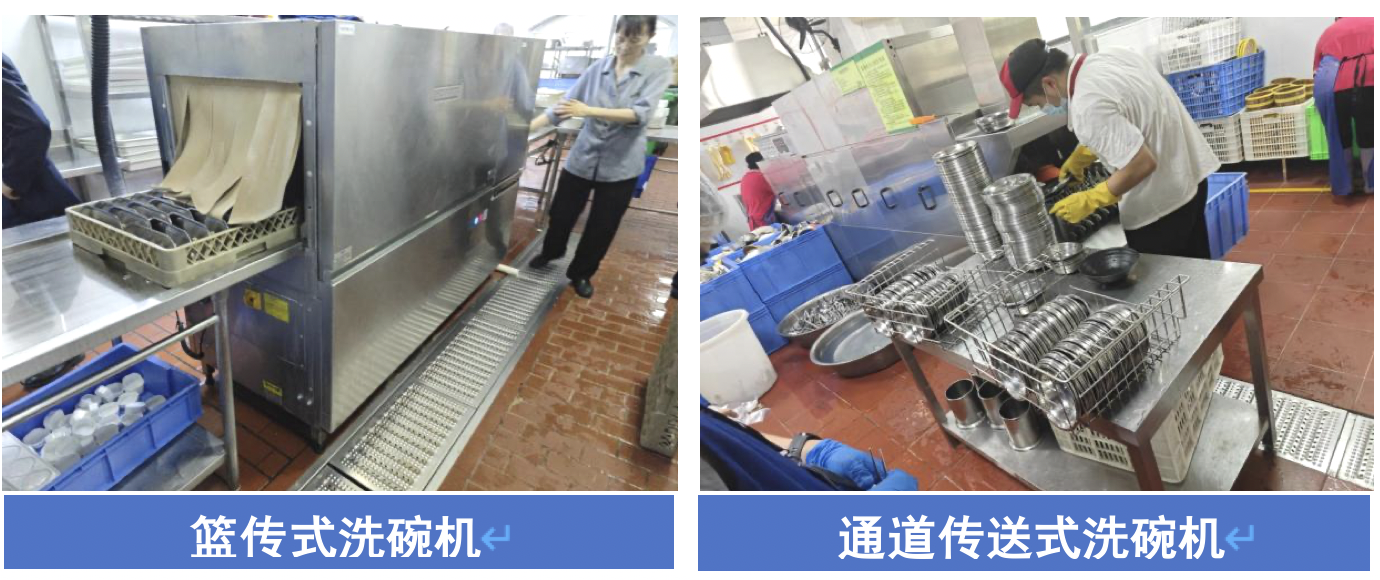
Cleaning site Image source: Xiamen Municipal Market Supervision Bureau
Machine-washing dishwashers are mainly basket-conveyor or channel-conveyor. In this study, three large hotels or school canteens using the above-mentioned dishwashers were selected for field evaluation. The research results show that:
-The components of anionic detergent will not exceed the standard after machine washing.
Detergents used by three main bodies-Diebao 100 dishwasher lye, machine washing detergent (lye) and dishwashing powder (sodium carbonate) all meet the quality requirements according to the national standard, and no anionic synthetic detergent components were detected. This is mainly because the washing principle of machine washing detergent is different from that of hand washing detergent. Hand washing detergent mainly relies on anionic synthetic detergent to emulsify with oil, so as to achieve the effect of removing oil. The machine-washing detergent is saponified by its alkaline components and hot water with the grease on the surface of tableware to dissolve the grease and achieve the effect of degreasing. Therefore, as long as qualified detergents are used for machine-washed tableware, there will be no risk of excessive anionic detergents.
-How to sterilize machine-washed tableware?
(1) The basket dishwasher is washed at high temperature (70-80℃). After washing, the surface temperature of tableware is high, so the residual temperature can be used to evaporate the water on the surface of tableware. Therefore, the correct treatment method after machine washing-take out the tableware and discharge it on the clean table, and then put it in the cleaning cabinet when the temperature drops to normal temperature. If the washed tableware continues to be placed in the revolving basket, it is not conducive to the evaporation of water on the surface of tableware, and the detection rate of coliform bacteria is still 8%.
(2) The channel conveyor dishwasher needs high-temperature disinfection after machine washing. Because the washing temperature of this kind of dishwasher is low (the highest water temperature of this test model is only 55℃), there are still many water stains on the surface of the tableware after cleaning, and no coliforms were detected after disinfection by high-temperature hot air disinfection cabinet.
"dispel doubts:
Doubt 1: Is it useful to make hot meals before meals?

Cleaning process Image source: Xiamen Municipal Market Supervision Bureau
The reporter’s visit found that many citizens must insist on cleaning it again with hot water when using the tableware provided by the merchants.
"I usually eat outside, and I will use hot water to iron and rinse the dishes before eating." Ms. Chen, who dines at a food stall on Hubin North Road, said that no matter whether the sterilized tableware provided by the merchant looks clean or not, she will scald it with hot water and rinse it. Ms. Chen said that she had also encountered stains or oil stains on sterilized tableware provided by merchants.
So, does pre-meal ironing have an effect on reducing the coliform bacteria in tableware? In the sampling inspection of this study, the experimenter prepared the contaminated tableware containing coliform bacteria and cleaned it. Then, hot water with different temperatures (70℃, 90℃, 100℃) was used to simulate the process of scalding the washed tableware samples before meals, and the scalding treatment was carried out-the hot water was poured to two-thirds of the capacity of the tableware and shaken for 4-6 seconds. Through data comparison, it is found that: (1) scalding with hot water above 70℃ can reduce the detection rate of coliform bacteria to a certain extent, but it cannot completely kill coliform bacteria; (2) The effect of removing anionic synthetic detergent is small. The detection rate of anionic synthetic detergent only decreased by 8% when the scalding water temperature increased from 70℃ to 100℃.
Doubt 2: Does the storage method affect the cleanliness of tableware?
In daily operation, the longest storage time of tableware in large and medium-sized restaurants and hotels is about 18 hours (from the end of dinner to the beginning of lunch the next day), and the longest storage time of campus canteens is about 36 hours (from the end of lunch on Friday to the beginning of lunch next Monday). In this study, the tableware to be inspected is stored in three common ways, namely, on the dining table/table, cleaning cabinet and dining cabinet, and the storage time is set to 0-72 hours, and then the coliforms are detected. Through data comparison, it is found that: (1) Tableware placed directly on the dining table or table after cleaning is easily affected by pollutants such as suspended dust, and the risk of exceeding the standard of coliforms in tableware is greater. (2) Tableware stored in a cleaning cabinet or a dining cabinet is less affected by air dust, and the surface of the tableware can be effectively kept dry, so the probability of detecting coliforms is low, and no coliforms are detected in the tableware stored in the dining cabinet for 72 hours in the experimental group.
The results show that the cleaned tableware is placed in a clean, dry and sealed disinfection cabinet or cleaning cabinet, which is conducive to maintaining its cleanliness; If it is necessary to put the tableware on the dining table and table in advance, it is suggested that the time for putting the tableware should not exceed 12 hours. Putting the tableware upside down will help to avoid dust and other pollutants from polluting the tableware.
"Consumer suggestions:
1. Attention: First check whether the hotel has a disinfection cabinet, whether the tableware in the disinfection cabinet is standardized, whether the disinfection cabinet is started and whether it works normally.
2. Look closely: Reusable tableware should be dry and waterless, with a smooth surface.
3. Inquiry: Before using, ask the restaurant whether it has been disinfected, and refuse to use non-disinfected reusable tableware.
4. Note: If you want to iron the tableware, try to iron it with high-temperature boiling water for more than 10 minutes, and increase the number of irons; It is recommended not to put everyone’s tableware in a big basin when scalding to avoid cross-contamination. Use chopsticks and spoons when eating.
"Unqualified items:
Coliform group is one of the commonly used indicators at home and abroad. Its hygienic significance: first, as an indicator bacteria that food is polluted by human and warm-blooded animal feces; Second, as an indicator of food contaminated by intestinal pathogens, it suggests that food is more likely to be contaminated by pathogenic bacteria (such as Salmonella, Shigella, Escherichia coli causing diarrhea, etc.). The unqualified coliform bacteria in food shows that the food has hygienic quality defects and is potentially harmful to human health.
Anionic synthetic detergent is the main component of detergent used in daily life, and its main component is sodium dodecyl benzene sulfonate. Anionic synthetic detergent was detected in reusable tableware. It may be that some units used too much detergent and didn’t wash it with enough water, or the washing water in the tableware rinsing pool was reused, or there were too many tableware, which caused cross-contamination and then remained in tableware.