What attracts you to the Himalayas? Listen to what they say.
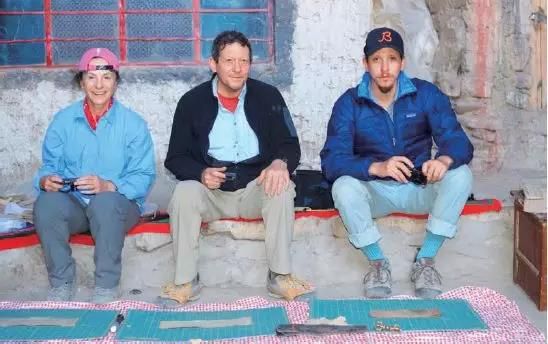
Thomas Pritzker (middle), Margaux and their son David, taken in Xizang in 2011. Figure/provided by respondents
Tubo conjecture of Pritzker family
Our reporter/Li Mingzi
Published in China Newsweek, No.907, July 15th, 2019.
Dunhuang, located in the northwest of Gansu Province, is world-famous for its grottoes and murals. More than 1200 years ago, Dunhuang was occupied by Tubo, but the east and west along the Silk Road were not cut off. The Tang Empire in the East, Persia, Sogdian and emerging Arabia in Central Asia, and Nepal and India in the south all stopped to rest. Different cultural customs stirred up and merged here, remaining in people’s costumes, utensils and religious statues at that time, and being forgotten with the collapse of the dynasty.
"It was not a backward and closed dynasty in the stereotype. Tubo had extensive contacts with all parts of the world." Borrowing more than 120 cultural relics from more than 30 institutions around the world, David Pritzker pieced together his conjecture about the aristocratic life of the Tubo dynasty, including the art collection of his Pritzker family for more than 40 years.
The Pritzker family, who is famous for setting up the Pritzker Architecture Prize, planned an "Exhibition of Tibetan Art Treasures" in Dunhuang, China. As a curator, David Pritzker told China Newsweek, "For me and my family, this exhibition has been a long-cherished dream." This dream was supported by National Cultural Heritage Administration of China and the host Dunhuang Research Institute. Luo Huaqing, vice president of the institute, said, "We hope to provide an original context for the exhibition."
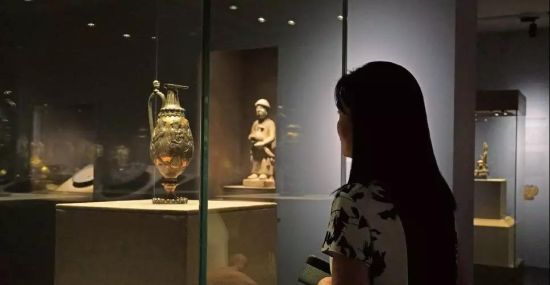
The audience visited the exhibits of the "Tubo Period Art Treasures Exhibition". Photo courtesy of Dunhuang Research Institute
Oriental adventure
"What attracts you in the Himalayas?" David never asked his parents this question. Although he has followed his parents to explore the Himalayas every summer since he was five years old, this is a question that his grandfather once asked his father.
In 1975, David’s father Thomas Pritzker and his fiancee Margo first came to the Himalayas. "We love the mountains, the friendly people and the culture here. It was a great experience." Thomas told China Newsweek.
Different from the modern European civilization developed from ancient Greek culture, the Himalayas, stretching more than 2,400 kilometers eastward from Kashmir to the southern part of the Qinghai-Tibet Plateau, bear the admiration and worship of countries and regions along the way for thousands of years. In Sanskrit, "Himalaya" is translated as "snow area", and every mountain peak, lake and river is regarded as a sacred incarnation by local people. Mount Everest means "mother of the earth" in Tibetan, and on the other side of the mountain, it is called "Sagarmata", which is the "heavenly palace" in Nepalese hearts.
"At first, we just wanted to experience another culture, but it gradually became an exploration and love that only increased." Thomas said that he and Margo also spent their "super-long" honeymoon in the Himalayas. They walked north through the mountains and then walked more than 800 kilometers along the northeast slope of the mountain until they reached a lonely place.
This time-consuming hobby did not delay Thomas’s main business. He took over the family business as his father wished. The development of the Pritzker family in the United States can be traced back to 1881. Thomas’ great-grandfather Nicholas came to Chicago from a Jewish quarter near Kiev, the capital of Ukraine, and finally founded a law firm. By the time Thomas’ father Jay Pritzker was born, this huge Jewish family had realized their American dream. In 1957, Jay led his family to another peak-the acquisition of Hyatt Regency. Today, the Hyatt Regency Hotel Group, headquartered in Chicago, operates more than 750 hotels and resorts in 55 countries around the world, with a market value of more than 8 billion US dollars.
The Pritzker Prize for Architecture, co-founded by Jay and his wife in 1979, is selected once a year and is known as the "Nobel Prize in Architecture". In 2012, after Thomas took over as the chairman of the prize foundation, the Pritzker Prize for Architecture was awarded to China architect Wang Shu for the first time, which made this award enter the domestic public view from the architectural field.
Thomas, who has several jobs, has never stopped exploring in Asia. In the autumn and winter of 1988, he and Margo’s expedition team welcomed new members. Five-year-old David came to the Himalayas for the first time. At that time, he was put in a basket and carried by the locals. Almost every summer after that, David would come to Nepal for a holiday. By the age of twelve or thirteen, he began to take part in more serious archaeological research.
On a trip around 2000, David and his parents found a hidden library in a temple in western Nepal. Through measurement, they found that the outside of the temple was much larger than the inside, but the monks in the temple did not agree to push down the wall until they promised to bear the consequences of pushing the wall, "including the repair of the roof and other places." David added, "The result was unexpected. There were 13th century books in it, just like the Tibetan Sutra Cave in Dunhuang."
"In the process of archaeology, we gradually discovered the connection between the East and the West (from cultural relics), and they once influenced each other." Margo told China Newsweek that at that time, the study of western civilization in Europe and America was relatively mature, while the study of eastern culture was just beginning. These findings inspired the Pritzker family to explore more enthusiastically.
The summer after graduating from Stanford University, David was invited to work as an assistant to a curator in new york. With more and more consulting and curatorial work, David found that he needed a more professional theoretical background, so he went back to school and finally got a doctorate from Oxford University, England, focusing on the study of early Tubo literature and historiography.
In the British Museum and the French Ji Mei Museum, David studied and translated many manuscripts from Dunhuang, and read them for hours in a closed space alone. "Literature research is very hard, and I am glad that I finally returned to my favorite art world." David said. It was not until 2017 that he came to Dunhuang for the first time, but he had read Dunhuang numerous times before.
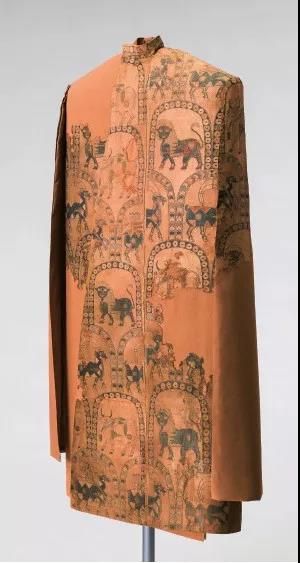
Embroidered lion, deer, cow and goat patterns and Tibetan cloak with fake sleeves.
Tubo conjecture
In the mandala with the background of crimson and dark brown, the thick lines depict the outline of Manjusri Bodhisattva, with strong body and solemn expression. Mandala is Sanskrit, translated into altar, with a round outside. In different caves at the same time, there is another mural with different styles. The Buddha statue is elegant and soft, with light outline lines, and the lotus petals are plump, mainly in blue and blue tones.
Two artistic styles from different regions coexist in this group of caves, which is only a part of Dongga-Piyang Cave. In 1992, the Xizang Autonomous Region Cultural Relics Management Committee and Sichuan University formed an investigation team and found the remains of this Buddhist cave in Zhada County, Ali District, western Xizang. Huo Wei also participated in the investigation. He is now the dean of the School of History and Culture of Sichuan University and the curator of the Sichuan University Museum.
Huo Wei introduced in the book Guge Dynasty that in the 9th century, after the collapse of the Tubo Dynasty, the grandson of the last Zamparama led his men to flee to Ali, the highest altitude in Xizang, to marry the daughter of the local tribal leader and establish political power. Then, the local political power was divided into three parts, and the political power in Zada was the beginning of Guge Kingdom.
Dongga-Piyang Grottoes are considered to be the largest and best-preserved sites in Guge Dynasty, with a total of nearly 1,000. There are murals of Buddha, Bodhisattva, Feitian, Buddhist stories and so on in the Ritual Grottoes. "Its exquisiteness is comparable to Dunhuang Grottoes." Huo Wei said.
When Thomas heard about this archaeological discovery, he was very excited. He inquired about the details of the investigation activities in many ways, and obtained the approval of National Cultural Heritage Administration, China, and took David to visit Ali with Huo Wei’s team.
"Their family can bear hardships." Huo Wei told China Newsweek that he remembered that a rock climbing tool was used on an expedition. There were flying stones rolling down the mountain, and one of them hit David’s head, and the blood was flowing. When David dried the blood, Thomas calmly told David to keep climbing.
Perhaps because of hiking in the Himalayas since childhood, David, who was only 11 years old at that time, was obviously better than the adults in the delegation. In 1994, in a routine archaeological investigation in Zada County, David, who was at the forefront, first discovered a number of Buddhist grottoes, namely "Pargarb Grottoes". "At that time, we joked that this could be called David Grottoes." Huo Wei said.
Six years later, with the encouragement of Tom and Huo Wei, David wrote an article based on this investigation experience, which was published in the Hong Kong magazine Orientations, a publication for collectors and connoisseurs who love Asian art.
Theoretically speaking, China scholars began to study Tubo culture in 1950s. "But it was nearly thirty years before they really did it. From the late 1980s to the whole 1990s, it was the climax of archaeological discovery and research." Huo Wei explained that this is mainly because Xizang’s special natural conditions and limited archaeological technical strength need the help of scholars from outside the region, so it lags behind the archaeological work in other parts of China.
The unearthed cultural relics in recent years provide a powerful reference for restoring life in the Tubo period. In this exhibition, the Cultural Relics Bureau of Zhada County, Ali, Tibet, provided a pair of Jin Mianju with animal patterns unearthed in 2009, which came from the kingdom of Xiangxiong in the 2nd century A.D., which existed before the rise of Tubo and was later replaced by Tubo.
The history books of the Tang Dynasty called Xiang Xiong "Mutton Tong", and recorded that the leader of his noble family made his nose and eyes with gold after his death. "We only read it in books before, but now we can really see that the Tubo people do use a lot of gold." Huo Wei said that this animal pattern Jin Mianju has a crown and facial features, which is consistent with the literature.
"Archaeological findings show that the Tubo culture constructed by Tubo is a worldwide cultural system." Huo Wei told China Newsweek, "This is the first exhibition that brings together cultural relics from the Tubo period around the world."
See Dunhuang again
More than 120 exhibits of this exhibition are displayed on the first floor of the grotto cultural relics protection research and exhibition center in Dunhuang Mogao Grottoes. At the front is the collection of Thomas and his wife, a dress of aristocratic children in the Tubo period, with a red double-breasted shirt embroidered with bird patterns and a navy blue skirt.
"This is a small dress that combines things." Huo Wei said that the round flower pattern with lotus beads on the outside embroidered with animals, lions, sheep or birds is called "Tuanke", which comes from Sogdian in Central Asia, but the duijin is a typical Tang suit. "This shows that Tubo has absorbed both Tang and Western cultures."
Another gold-plated silver Hu bottle in Guyuan Museum in Ningxia tells a Greek myth. The belly of this golden flower and silver Hu bottle consists of three groups of pictures. In front, the young Paris gives the golden apple to Aphrodite, the goddess of love. On the left, Paris robs the beautiful Helen with the help of the goddess of love. Turning to the right, Helen has returned to her husband Menelaus.
This gold-plated bottle with an ancient Greek story crossed Qian Shan, and finally appeared in the tomb of Li Xian, the general of the Northern Zhou Dynasty in distant China. Some researchers suspect that it is the product of the imitation of Greek images by craftsmen of Sassanian dynasty in Persia in Central Asia, or it is from the hands of craftsmen who were in the summer under Sassanian rule and were deeply influenced by Greece.
This unimaginable connection between the ancient East and the West is thus hidden in the treasures of the exhibition. One of David’s favorite collections is the fish-patterned gold-plated silver finger cup of the god beast and bird in the Tubo period. The outer wall of this cup is a lion relief symbolizing kingship, and the image in the cup is quite meaningful. The bottom of the cup depicts three small fish, surrounded by a circle of lotus flowers, four big flowers and four small flowers are arranged in a cross, and a mandarin duck stands on each big lotus flower. These images can be found in the floral decorations in the Tang Dynasty.
Three small fish heads face inward and outward, two of them still have faces, and the third one looks down as if it were dead. "This is very similar to the Story of the Smart Fish in Sogdian literature." David said, according to legend, a fish found that the water in the pool was going to dry up, told the other three and escaped. The three fish thought they were clever, sneered at the advice and finally died in the river. Of the three fish left in the cup, the cleverest one floats on the water with his head down, while the other two face fish symbolize the false wisdom and arrogance in the story.
David hopes to reproduce the life of the Tubo royal family, but some people question that there seems to be no royal cultural relics unearthed in the Tubo area during the Tubo period. These collections are either from the surrounding areas of Tubo, or from the Xiangxiong Kingdom before the Tubo Dynasty and the Guge Dynasty after Tubo.
"The objective reason is that out of respect for the Tibetan people and their culture, there has been no excavation of the tomb of the Tubo king." Luo Wenhua, director of the Institute of Tibetan Buddhist Cultural Relics of the Palace Museum, told China Newsweek, "It is very difficult to show Tubo through cultural relics. We must know what we need and where to find it. This is also the most discussed and difficult place in the curatorial process." The final plan is that when the existing Tubo surrounding culture is presented, the Tubo culture will emerge.
Just like another work of art recommended by David, it comes from the collection of the Textile Research Center of the Swiss Abegg Foundation. It is a huge hanging brocade with a length of 2 meters and a width of 1.73 meters, embroidered with a lotus pattern, which came from Central Asia during the Tubo period, but no one can confirm that it was once hung in the golden account of the Tubo royal family. "However, judging from the grade and quality of these cultural relics, at least they are all supplies of the royal family." Huo Wei said.
"The exhibition landing in Dunhuang is also the responsibility of Dunhuang as a civilized hub of the Silk Road." Zhao Shengliang, president of Dunhuang Research Institute, introduced at the opening ceremony that from the end of the 8th century to the first half of the 9th century, it was the Tubo period in Dunhuang history, when Buddhism continued to flourish in Dunhuang. During this period, 56 caves were built in Mogao Grottoes, and more than 20 caves of the previous generation were built, which combined the styles of the Tang Dynasty in the Central Plains, Central Asia and even India. It is an important and precious material for studying the history and culture of China and Tibet.
A successful exhibition needs both academic value and popular science. "For most visitors, it is not to let them discuss difficult academic issues, but to let people feel things that they have never experienced before and find problems that were ignored before." Luo Wenhua said, "This is the significance of this exhibition, seeing things that were rarely seen before. Textbooks all over the world have hardly introduced the historical features of Tubo in detail. "
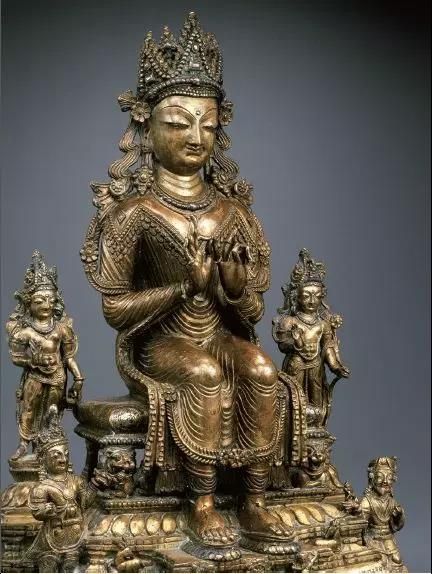
Statues of Maitreya sitting on Buddha, two Bodhisattvas and some royal patrons inlaid with silver and copper.
After the opening ceremony, Reuben, David’s 5-year-old son, introduced his favorite work of art to Hu Bing, deputy director of National Cultural Heritage Administration, China. It was a gold-plated silver cup in the shape of an antelope’s head in Sassanian period. "After pouring the liquid from the sheep’s head, it will flow out from the mouth below." Ruben said.
The word "Laitong" originated from Greek, and was first regarded as a sacred object by the Greeks. It is said that at that time, people thought that using "Laitong" cup to inject wine could prevent poisoning, and then it became a luxury of the nobility.
"I never taught him. I think he must have heard it when I introduced it to others, and then remembered it." David told China Newsweek, "My whole growth is closely related to these histories and cultures. Through field trips, I listen, see, taste and feel, instead of staying in museums. Maybe it’s the same for Ruben. "
Editor in charge: Guo Huifen